Local Computer Vision: Upgrade CCTV Without Subscriptions in 2026
- The Video Surveillance Dilemma in the Subscription Era
- Architecture of a Smart and Local NVR
- Hardware Accelerators: The Engine of Visual Inference
- Technical Deployment Guide and Software Stack
- 2026 Market Cost Analysis: The CAPEX vs. OPEX Verdict
- Enterprise Use Cases and Return on Investment (ROI)
- Technical Challenges, False Positives, and Long-Term Maintenance
- Conclusion: Owning Your Computer Vision Infrastructure
The video surveillance and perimeter security market has undergone a radical metamorphosis over the last half-decade. We have transitioned from closed-circuit television (CCTV) systems that recorded endless hours of static video onto mechanical hard drives, to intelligent systems capable of distinguishing between a stray cat, a shadow cast by a tree, and a human intruder jumping a fence at three in the morning.
However, this evolution has come with a suffocating corporate toll. Brands like Ring, Nest, Arlo, and massive B2B security giants have pushed consumers and businesses alike into a forced subscription model. You purchase the hardware, but if you want the Artificial Intelligence to identify packages or people, and if you want to store those events, you are locked into a perpetual monthly fee. In 2026, subscription fatigue is a financial reality that chokes the operating budgets of SMEs and frustrates domestic users.
Against this cloud oligopoly, a technical rebellion—silent but unstoppable—has matured thanks to open-source software. Today, in this deep technical dive, we will break down how to take generic or legacy IP cameras and connect them to a local "brain" that executes advanced computer vision models in real-time, without sending a single frame to third-party servers, and most importantly, without paying monthly fees.
The Video Surveillance Dilemma in the Subscription Era
To fully grasp the solution, we must first dissect the problem. The tech industry has perfected the "Hardware as a Service" (HaaS) model. Cameras are often sold with razor-thin profit margins or even at a loss, because the true revenue lies in customer retention over the years through recurring billing.
The Cloud-Tied Hardware Trap (Vendor Lock-in)
Vendor lock-in is the primary enemy of sustainable IT infrastructure. If you acquire a camera ecosystem from a cloud-dependent brand, your devices essentially become paperweights if the company decides to go bankrupt, hike its pricing policies, or discontinue support for your specific model (a scenario we have witnessed repeatedly with big-tech consumer lines). Furthermore, these cameras typically ship with their RTSP (Real-Time Streaming Protocol) locked down, preventing you from pulling the raw video feed to use in any third-party software.
Privacy, GDPR, and Video Stream Sovereignty
Beyond the financial drain, the constant transmission of video streams to overseas data centers poses an absolute compliance nightmare, particularly in Europe. Businesses monitoring their warehouses, offices, or loading docks are capturing biometric and behavioral data of their employees and customers. Delegating the custody and analysis of these videos to AI models hosted on shared servers in other jurisdictions is a massive risk under the 2026 GDPR framework. Data sovereignty demands that inference—the act of the AI "seeing" and deciding what is in the image—must happen physically inside the building.
Architecture of a Smart and Local NVR
A traditional Network Video Recorder (NVR) is limited to passively receiving video and writing it to a disk. A modern Smart NVR performs three simultaneous tasks: it captures the video feed, decodes the keyframes, and passes them through a Convolutional Neural Network (CNN) to detect specific objects, instantly discarding the rest of the useless footage.
Repurposing RTSP IP Cameras: One Man's Trash is Another Man's Treasure
The beauty of local computer vision (Edge AI) is that it does not require the camera itself to be "smart". In fact, we actively prefer "dumb" cameras. Any IP camera manufactured in the last ten years that supports the standard RTSP or ONVIF protocols is perfectly viable for this project.
You can acquire generic 4-Megapixel or 4K cameras from brands like Dahua, Hikvision, Reolink, or Amcrest for a fraction of the cost of modern "smart" equivalents. The camera only has one mission: to capture light, compress it into H.264 or H.265 formats, and send it through the network cable (ideally via PoE - Power over Ethernet) to our central server.
The Local Brain: Why Frigate NVR Dominates the Open Source Market
In the open-source NVR ecosystem, historical giants like ZoneMinder, Shinobi, or Blue Iris (the latter being paid but highly popular) have dominated discussions. However, in 2026, the de facto standard for real-time object detection is undeniably Frigate.
Frigate was engineered from the ground up to work specifically with Artificial Intelligence accelerators. Unlike legacy software that analyzed pixel changes to detect motion (which generated thousands of false positives when a tree swayed or it rained), Frigate uses AI models—like YOLO (You Only Look Once)—trained on massive datasets (such as the COCO dataset) to identify human silhouettes, vehicles, dogs, cats, or packages with astonishing accuracy.
Hardware-Assisted Video Decoding
The bottleneck in these systems is rarely the AI inference itself, but the preceding step: decompressing the incoming H.265 video stream to extract individual frames for the AI to "look at." Frigate shines because it allows administrators to delegate this heavy decoding task to the integrated graphics card (iGPU) of Intel processors via QuickSync technology, or to dedicated GPUs. This offloads the central processor (CPU) almost entirely, keeping the system cool and responsive.
Hardware Accelerators: The Engine of Visual Inference
If you attempt to make a conventional CPU, such as an Intel Core i5 or an AMD Ryzen, run object detection on six cameras at 5 frames per second simultaneously, the processor will instantly hit 100% load. It will generate extreme heat, consume massive amounts of power, and eventually crash. Neural network inference requires specialized silicon.
Google Coral TPU: Scarcity, Reality, and Alternatives in 2026
The Google Coral Edge TPU (Tensor Processing Unit) revolutionized this sector. It is a tiny coprocessor (available in USB or M.2 formats) capable of performing 4 trillion operations per second (4 TOPS) while consuming barely 2 watts of power. In past years, they suffered a brutal shortage due to the global semiconductor crisis. Today, in 2026, supply chains have stabilized, although prices are no longer the bargain they promised to be at their original launch.
Currently, an M.2 Coral TPU hovers around €60, and the USB version can usually be found for €85. It is a mandatory investment for this architecture. Adding a single Coral to a basic server allows you to analyze video feeds from more than 10 cameras simultaneously with inference times of a mere 10-15 milliseconds per frame.
Intel Processors with QuickSync and Modern NPUs
If sourcing a Coral is not an option, the broader hardware industry has reacted. The most recent architectures from Intel (such as the Meteor Lake series and beyond) include integrated NPUs (Neural Processing Units). Open-source projects like OpenVINO allow tools like Frigate to leverage these specific, native Intel AI instructions, achieving performance levels that rival the Coral without the need to purchase external hardware.
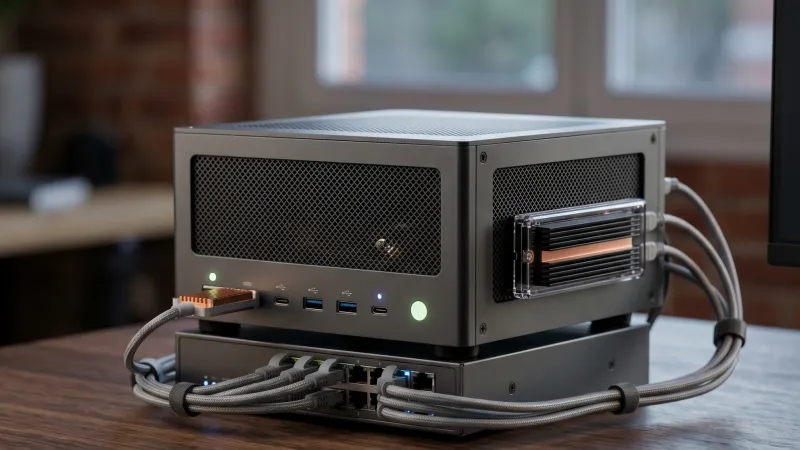
Low-power "Mini PCs" based on processors like the Intel N100 have become the undisputed kings for home security and small office servers. They cost a mere €180 (often with RAM included), consume between 6 and 15 watts, and their integrated graphics (Intel UHD) can decode ten 4K video streams in hardware without breaking a sweat.
The Critical Role of Fast Storage in Event Processing
When the AI detects a person crossing the imaginary perimeter line you drew in the web interface, the system must immediately write that video segment to disk, along with metadata and high-resolution snapshots. Doing this simultaneously for several cameras quickly destroys mechanical hard drives (HDDs) due to random read/write latency constraints.
The database (usually SQLite in these environments) and the recent video segment cache require high-speed access. Fortunately, as we actively track the 2026 market, the cost of fast storage is no longer a barrier. To maintain the operating system, the Docker containers, and the cache of recent recordings, a basic 1TB NVMe PCIe 4.0 SSD is the standard choice, with prices having stabilized around €50 on platforms like Amazon. This small, highly affordable investment ensures that the event review web interface loads instantly and the database avoids corruption under heavy I/O loads.
Technical Deployment Guide and Software Stack
Implementing this is not a simple "Plug and Play" endeavor, but containerization has turned what used to be weeks of compiling code into minutes of deployment. We will assume you have a Mini PC running Debian Linux or another Ubuntu-based distribution.
Host Preparation: Docker and Docker Compose
The entire ecosystem runs within containers. Docker isolates the software dependencies, preventing host operating system updates from breaking your carefully configured Frigate installation.
The docker-compose.yml file is the heart of the setup. Here, you define the Frigate image, map the web ports (usually 5000 for the UI and 8971 for secure connections), and crucially, pass the hardware through to the container (mapping devices like /dev/dri/renderD128 for the integrated GPU and the USB/PCIe bus for the Coral TPU).
Frigate YAML Configuration File
The actual brain of Frigate is configured via a single frigate.yml file. This is where engineering magic meets operational reality. A robust configuration requires defining several core pillars.
First, Frigate does not live in isolation; it requires an MQTT (Message Queuing Telemetry Transport) server, such as Mosquitto, to broadcast real-time alerts. When Frigate detects a "human" with 85% confidence, it publishes a message to MQTT. Your home automation system (like Home Assistant) reads this message and instantly turns on the exterior floodlight or sends a push notification to your phone with a snapshot of the intruder.
Next, you must define your Detectors and Models. You explicitly tell the software which silicon will handle the AI math (e.g., specifying the EdgeTPU on the USB bus). Following this is the meticulous setup of Cameras and Video Streams. The industry standard best practice is "Dual Streaming." You configure the camera to send a low-resolution sub-stream (e.g., 720p at 5 fps) for continuous AI detection to save immense computational resources, and a high-resolution main stream (e.g., 4K at 15 fps) dedicated exclusively to saving the video clip when an event actually occurs.
Finally, there is the Fine-Tuning of Detection (Objects & Filters). You do not want the camera recording every pedestrian walking on the public sidewalk. In the configuration, you draw polygonal zones. You instruct the AI: "Look for people and vehicles. But only save the video and trigger an alert if a 'person' explicitly enters the polygon labeled 'Front_Porch' or 'Driveway'."
2026 Market Cost Analysis: The CAPEX vs. OPEX Verdict
As tech analysts, it is our duty to evaluate this technology not just for its technical fascination, but for its financial viability in the current 2026 economic climate.
Proprietary Cloud Systems
A cloud-based ecosystem with 4 high-resolution cameras (from brands like Nest or Ring) implies an initial Capital Expenditure (CAPEX) of roughly €400 - €600. However, cloud storage and AI features require a subscription that hovers around €10 to €15 monthly (Operational Expenditure - OPEX). Over a standard 5-year lifecycle, you will have paid approximately €1,500, and you will still not own your video data.
Open Source Systems (Frigate + Custom Hardware)
The initial cost is slightly higher and requires technical integration effort, but the OPEX drops to absolutely zero, save for electricity.
- Intel N100 Mini PC (Host Server): €180
- Google Coral TPU Accelerator: €60 - €85
- Storage Architecture (SSD + HDD): The NVMe SSD for the OS and cache costs the aforementioned €50. Optionally, a 4TB surveillance-grade mechanical drive (like WD Purple) to store deep historical event archives adds about €90. Total Storage: €140
- PoE Network Switch (8 Ports): €60
- 4 x Generic 5MP PoE IP Cameras: €160 (€40 each)
Total Estimated 2026 Cost: Approximately €625.
From month one onwards, the software cost is €0. You possess a system with zero cloud latency, featuring object detection capabilities that outperform many commercial platforms. Furthermore, it is infinitely scalable to 10 or 15 cameras in the future by simply purchasing the physical hardware, without ever upgrading a flat-rate software tier.
Enterprise Use Cases and Return on Investment (ROI)
While the primary motivation in the residential sector is long-term savings and absolute privacy, in the corporate arena, open-source visual AI opens doors to advanced operations without requiring multi-million dollar contracts with integration firms.
Logistics, Loading Docks, and Fleet Control
In distribution hubs, conventional IP cameras are integrated with Frigate and Automatic License Plate Recognition (ALPR) modules. By completely bypassing the cloud, the local system reads the license plate of delivery trucks in milliseconds, cross-references the data with the local manifest database, and triggers the physical barrier relay without human intervention—even if the industrial warehouse's internet connection goes down.
Retail, Heat Maps, and GDPR Compliance
Supermarkets and large retail chains need to understand customer flow: which aisles see the most traffic and where physical bottlenecks occur. Commercial turnkey solutions send this video data (and the faces of customers) to third-party servers, demanding complex legal consent architectures. By deploying Frigate locally, the hardware analyzes the video stream, counts the "human silhouettes," generates statistical data, and instantly destroys the video footage. By never storing or transmitting biometric data off-site, the system achieves "Privacy by Design," making it inherently GDPR compliant.
Technical Challenges, False Positives, and Long-Term Maintenance
True to our principle of avoiding "magic bullet" narratives, we must address the real-world drawbacks of abandoning commercial turnkey security systems.
The Hell of Shadows and Reflections
Although YOLO models are incredibly precise, they are not infallible. A camera facing a driveway might detect the elongated shadow of a tree at sunset, or the reflection of car headlights in a puddle, and classify it with a 60% probability as a "person".
This reality requires the system administrator to spend the first few weeks actively reviewing metrics and tuning the configuration. It will be necessary to create "Motion Masks" (telling the AI to ignore pixel changes in the tree leaves) or raise confidence thresholds (requiring the model to be 75% sure before triggering an alert). In a commercial system, engineers in California handle this; with Frigate, you are the engineer.
Hardware Degradation and Thermal Management
A Mini PC running 24/7/365 in an unventilated telecom closet is going to suffer. The Coral TPU accelerator can reach very high operating temperatures under intense inference loads. If the silicon overheats, it will trigger "thermal throttling" (reducing its clock speed to avoid permanent damage). This dramatically increases inference time and can cause the system to drop critical frames—meaning someone sprinting past the camera might not be detected.
Ensuring proper heat dissipation, utilizing appropriate passive aluminum chassis, and setting up temperature alerts (monitored via dashboards like Grafana or Home Assistant) is an unavoidable step in long-term system maintenance.
Conclusion: Owning Your Computer Vision Infrastructure
The state of the art in video surveillance in 2026 clearly demonstrates that technological sophistication is no longer held hostage by massive corporations or perpetual subscription models. Affordable hardware, exemplified by low-power Mini PCs, stable-priced high-performance solid-state storage, and dedicated AI accelerators, has perfectly converged with the zenith of open-source software.
Building a local Smart NVR with Frigate undeniably requires an initial investment of time, patience, and technical proficiency. You must be willing to wrestle with YAML files, Docker container configurations, and the learning curve of calibrating false positives.
However, the payoff is monumental. For the residential user, it means 100% shielding of their home's privacy, evading recurring costs, and taking absolute ownership of their digital infrastructure. For the SME, it represents access to visual analytics, perimeter control, and reactive automation that, just a few years ago, required insurmountable security budgets.
Artificial intelligence has matured to the point where it can be neatly packaged in a small aluminum box tucked away in an IT closet. We no longer need to send the video feeds of our personal lives or our businesses to a server five thousand miles away just to know if the person knocking on the door is a delivery driver or a stranger. Computer vision has finally come home, and it is here to stay.