Local AI in Industrial SMEs: Costs & Data Sovereignty in 2026
- The Invisible Revolution: Local Artificial Intelligence at the Heart of the Industrial SME
- The Paradigm Shift: From Cloud to Edge Computing in Manufacturing
- Hardware Architecture: Building the Local Brain
- Software Ecosystem: Orchestrating the Iron
- Real-World Use Cases: Return on Investment (ROI) in Weeks
- Challenges and the Reality of "In-House" Maintenance
- Final Verdict: The Era of Digital Autarky
The Invisible Revolution: Local Artificial Intelligence at the Heart of the Industrial SME
In the current technological landscape of 2026, the dominant narrative seems almost exclusively focused on cloud behemoths and hyperscale data centers. However, far from the glittering headlines of trillion-dollar Silicon Valley corporations, a much more pragmatic tectonic shift is reshaping the backbone of the European economy: the adoption of Large Language Models (LLMs) executed locally, right on the factory floor, by small and medium-sized industrial enterprises (SMEs).
This phenomenon is not a passing fad. Rather, it is the result of a critical convergence of three factors: the drastic drop in consumer hardware prices, the maturity of open-source software, and, above all, an obsessive concern for industrial data sovereignty. What just two years ago required an IT budget that was completely out of reach for an automotive parts manufacturer or a food packaging plant, is today resolved with an initial investment that can be amortized in a matter of months.
The Paradigm Shift: From Cloud to Edge Computing in Manufacturing
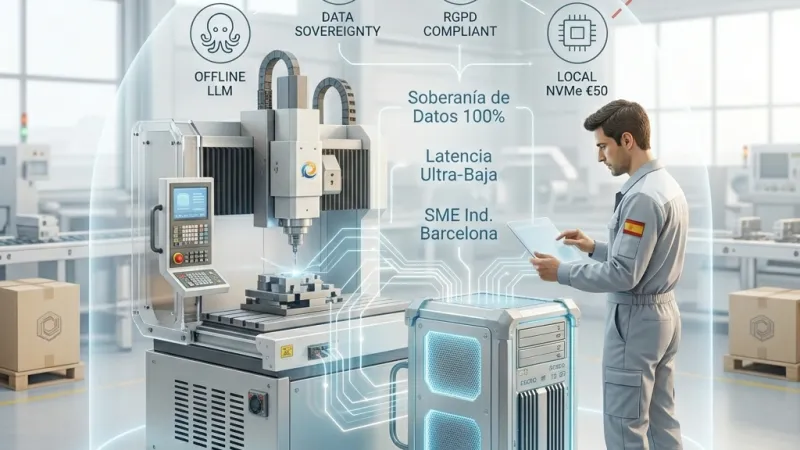
Cloud computing offered promises of infinite flexibility and boundless scalability, but the industrial fabric has discovered its sharp edges. Latency issues, recurring costs from API calls (token billing), and the constant transfer of intellectual property to third-party servers created a severe bottleneck. Edge AI—artificial intelligence processed directly on the company's own premises—has evolved from a mere technical curiosity into an absolute operational necessity.
The Obsession with Data Sovereignty
For a metallurgical factory that has spent three decades perfecting an alloy process, sending thermal sensor parameters, CAD diagrams, or maintenance logs to a public cloud is an unacceptable risk. The algorithms of big tech companies are fed, in part, by the constant stream of user data. In the B2B industrial environment, trade secrets and proprietary processes are often the only barrier to entry against low-cost foreign competition.
European Regulations and Protectionism
The definitive implementation of the European Union's Artificial Intelligence Act (AI Act) and the tightening of GDPR fines have created an environment where the fear of penalization outweighs the convenience of the cloud. If an AI hosted overseas analyzes supplier emails or worker performance data, the company exposes itself to complex and brutal audits. Running the model completely "disconnected from the router" (offline) instantly nullifies the vast majority of these legal risk vectors.
The True Cost of Information Leaks
It is not solely about regulations. In a highly competitive market, a slight adjustment in the calibration of a CNC machine can represent savings of thousands of euros in material waste. If the optimization of that process is analyzed by a third-party AI, the digitized "know-how" becomes exposed to software supply chain vulnerabilities. Total isolation—implementing air-gapped systems—ensures that the industrial "recipes" stay strictly inside the company's kitchen.
Hardware Architecture: Building the Local Brain
Let's address the reality of market prices in this current month of April 2026. The viability of this ecosystem is based on hardware that we can acquire through standard commercial distribution channels, without the need for opaque contracts with enterprise giants.
Evaluating Silicon: What is Actually Needed Today?
The core of any local AI is memory and parallel processing capacity. Unlike traditional software that heavily taxes the central processing unit (CPU), artificial intelligence inference devours VRAM (Video RAM) and secondary storage bandwidth. To make an AI "think," you have to load massive amounts of data into its working memory constantly.
The Storage Renaissance and Current Pricing
To load models ranging from 8 billion to 70 billion parameters (the current standards for complex industrial tasks), the speed at which model weights are transferred into working memory is critical. This is where the market has been incredibly generous to the SME. Solid-state drives (SSDs) have stabilized their costs drastically. As we have been tracking, high-speed 1TB NVMe SSDs have gone up slightly but are still hovering around a highly affordable €50 on platforms like Amazon. This democratization of fast storage allows IT departments to build redundant arrays in every workstation without breaking the annual budget.
NVMe and SSD Memories: The Data Pipeline
When an operator asks the local AI to cross-reference the 500-page PDF maintenance manual of a plastic injection molding machine with the error logs of the past week, the system must read immense fragments of vectorized text. A traditional mechanical hard drive would take minutes to fetch this data; an SSD at current 2026 prices resolves it in milliseconds. This price drop to €50 makes setting up dedicated machines in different zones of the plant financially trivial.
Impact of Latency on Plant Operations
In the industrial environment, a three-second delay in a query can mean a stopped assembly line. The combination of ample VRAM and ultra-fast SSD storage ensures that the AI responds in real-time. It can interact with operators through industrial touch screens without perceptible delays, drastically improving the worker's cognitive ergonomics and reducing operational frustration.
Software Ecosystem: Orchestrating the Iron
Having the best server in the world is completely useless if the software requires a PhD in computer science to compile. The true miracle of 2026 is the maturity and user-friendliness of the orchestration layer.
Open Source Models: Llama, Mistral, and the European Alternative
The monopoly of closed-source models has been shattered. Today, a company can freely download models with permissive licenses for commercial use. These digital brains, pre-trained on billions of documents, undergo a process called Fine-Tuning or are utilized via RAG (Retrieval-Augmented Generation) entirely within the factory walls. They are injected with the company's specific manuals, repair histories, and safety protocols. Suddenly, a generic AI becomes the most experienced chief engineer on the warehouse floor.
Decoupled User Interfaces
Local tools now act as internal servers. By installing the core model on a central machine in the technical office, any employee can access a familiar chat interface from their rugged tablet on the loading dock. There are no complex learning curves; if they know how to use a standard messaging app, they know how to interact with the total knowledge base of the entire company.
Real-World Use Cases: Return on Investment (ROI) in Weeks
Technology adoption is never justified merely by novelty, but by the bottom line. Let's look at how local AI is eliminating classic bottlenecks and generating immediate ROI.
The Predictive and Corrective Maintenance Assistant
Modern industrial machinery comes with thousands of pages of manuals and cryptic error codes. Previously, a junior technician had to call external tech support or waste hours searching through dusty binders. Today, the technician simply tells their tablet: "Machine 4 is throwing code E-704 and smells like ozone." The local AI, cross-referencing the PDF manual and the failure history (hosted on that €50 SSD), responds instantly: "That indicates an imminent failure in the Z-axis frequency inverter. Cut the power immediately. The spare part is in aisle 3, bin B. Here is the step-by-step disassembly schematic."
Automating Procurement and Inventory Control
The purchasing department is often buried under delivery notes and invoices from hundreds of suppliers, many in non-standardized formats. A local AI agent configured to read the internal email inbox (without uploading the PDFs to the cloud) extracts the quantities, checks them against the purchase orders in the company's ERP, and alerts staff only when there are discrepancies in prices or delivery times. This turns exhausting administrative work into a simple human supervision of exceptions.
Generating Protocols and ISO Certifications
Maintaining quality certifications requires massive document bureaucracy. Every time a process changes in the factory, risk prevention manuals, quality protocols, and operator guides must be updated. The AI can draft these documents based on the voice transcription of the plant engineer who just modified the machine, automatically adapting the language to the strict format required by the ISO standard. This saves weeks of administrative work for quality managers.
Challenges and the Reality of "In-House" Maintenance
It would be irresponsible, as technology market analysts, to paint this scenario without showing the shadows. Maintaining local infrastructure comes with its own set of organizational challenges that must be addressed.
The Hidden "Technical Debt"
When you outsource to the cloud, you pay for someone else to update the servers. When you have it in-house, if the server crashes, the problem is yours. SMEs must deal with the thermal management of high-performance equipment in environments that are often not air-conditioned, and with protection against industrial dust, which is the sworn enemy of high-performance graphics cards and internal cooling fans.
The Risk of Confident "Hallucinations"
Language models are, at their core, sophisticated text prediction machines. If the operator asks how to repair a hydraulic press and the model does not find the exact answer in its local database, there is a risk that it will invent a procedure that sounds extremely plausible but is technically incorrect (a hallucination). In a software environment, a bug crashes an app; in a heavy machinery environment, a bug can cause a severe workplace accident.
Advanced RAG Systems as a Countermeasure
To combat this, the state of the art in 2026 demands that queries to industrial AI always return the exact documentary source. The answer should not just be "Tighten the valve to 40 psi," but rather "Tighten the valve to 40 psi (Reference: Technical Manual 2023, page 142)." This keeps the human strictly in the validation loop ("Human-in-the-loop"), ensuring that the AI acts as an intelligence amplifier, not as a substitute for the operator's professional responsibility.
Final Verdict: The Era of Digital Autarky
Market analysis leaves us with a crystal-clear conclusion: the scales have definitively tipped. Years ago, the cloud was the only option for advanced AI. Today, the aggressive price reductions in solid-state storage (those €50 per terabyte of high-speed memory), the stabilization of the prosumer GPU market, and the flourishing open-source ecosystem have built a direct bridge toward digital autarky for the SME.
Industrial companies implementing these systems today are not simply buying technology; they are securing their intellectual property and optimizing their margins in an economic environment where extreme efficiency is the only guarantee of survival. Artificial intelligence has stepped down from the unreachable servers of tech corporations to put on a pair of overalls in the industrial warehouses of our country.