2026 Guide: How to Build a Home AI Server (Hardware & Prices)
The Rise of Home AI Servers: Hardware, Pricing, and Reality in 2026
Barely two years ago, Artificial Intelligence was strictly synonymous with monthly subscription fees and data processing happening in distant server farms managed by giant tech corporations. However, as we navigate through April 2026, a powerful new trend has consolidated among technology enthusiasts, independent developers, and privacy-conscious users: the Home AI Server. The premise is highly seductive—having your own private ChatGPT, your own image generator, or a localized smart home assistant running physically in your living room, completely disconnected from the internet.
Yet, making the leap from theory to practice requires navigating a computer components market that has proven volatile and, occasionally, ruthless to the average consumer's budget. In this in-depth tech feature, we break down the technological and financial reality of building your own artificial intelligence ecosystem. We analyze real market costs, the necessary technical specifications, and answer the fundamental question: is the investment actually worth it?
The End of Cloud Dependency: Why Bring AI Home
Before analyzing silicon and euros, it is vital to understand the "why". Those who are investing heavily in dedicated AI hardware in 2026 are not doing so out of a passing fad. They are driven by three very specific vectors that the public cloud simply cannot comprehensively satisfy.
Absolute Privacy and Data Sovereignty
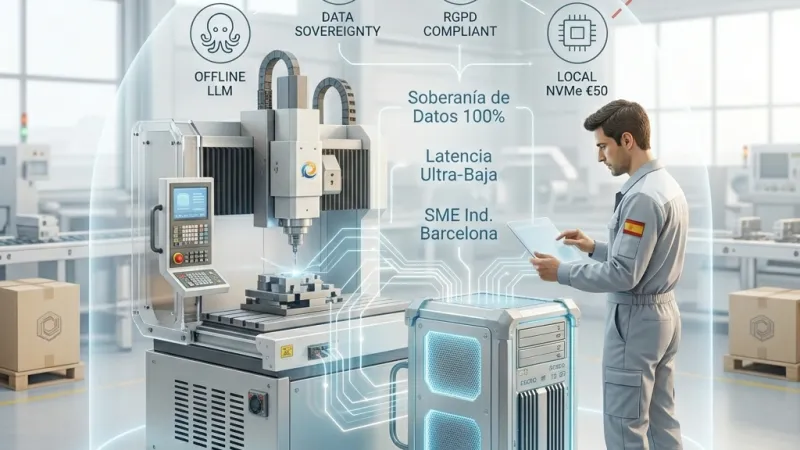
When integrating artificial intelligence with a smart home assistant (such as Home Assistant), we are granting it access to our microphones, security cameras, daily routines, and utility consumption data. Processing voice transcriptions and logical decision-making on a local server guarantees, by design, that no audio recording of our home will ever end up on third-party servers to "train future models". It is the ultimate air-gap barrier for domestic privacy.
Zero Latency and Operational Resilience
Relying on an external API means that your smart home assistant will fail to turn on the lights if your internet service provider experiences an outage, or if the AI provider's servers become saturated. Local processing reduces latency to mere milliseconds and makes the home completely independent of the external grid, guaranteeing operational resilience even during network failures.
Censorship and Uncensored Models
Commercial cloud models are heavily aligned and restricted by the corporate policies of their creators. This often results in "false positives," where the model refuses to write legitimate cybersecurity code or draft fictional stories about certain topics. The open-source community provides "uncensored" versions of powerful models like Llama or Mistral, which can only be executed freely on your own proprietary hardware.
2026 Market Analysis: How Much Does a Home AI Server Actually Cost?
This is where we must leave theory behind and face reality. As tech analysts, our duty is to evaluate the market using current prices. We are not going to recommend unattainable configurations or falsely promise that a recycled PC from 2015 will be able to run advanced models. If you are looking for complacent answers, this is not the place; we are going to break down the costs with the cold realism that an investment of this caliber demands.
Graphics Cards (GPUs): The Muscle of Inference and VRAM Inflation
In the gaming world, the raw power of the graphics chip (teraflops) is everything. In the world of local Artificial Intelligence, the reigning metric is VRAM (Video RAM). Large Language Models (LLMs) are massive files. For an AI to "think" and generate a response, you must be able to load its entire "brain" (its neural weights) into the memory of your graphics card.
The reality of silicon in 2026
A competent, quantized (compressed) 8-billion parameter model occupies about 6 to 8 GB of VRAM. More robust models of 70 billion parameters require between 40 GB and 48 GB of VRAM. This imposes a drastic barrier to entry.
- The Minimum Viable Product (Nvidia RTX 4060 Ti 16GB or AMD equivalent): In the current market, 16GB options are the absolute entry point for a decent server. An 8GB GPU falls short rapidly if you want to experiment beyond very small models. The price of mid-range graphics cards with high VRAM remains a bottleneck, currently hovering between €450 and €550.
- The Enthusiast Standard (Nvidia RTX 4090 24GB or next-gen equivalents): This allows running highly capable models at high speeds. However, its price remains prohibitive for most, comfortably exceeding €1,800.
- The Apple Silicon Alternative: Many developers are opting for Mac Studios or Mac Minis equipped with M3 or M4 processors due to their "Unified Memory" architecture. A Mac with 64GB of unified memory can allocate almost all of that memory as VRAM for AI tasks. Although the pure token-per-second performance is lower than an ultra-high-end dedicated Nvidia card, the memory-to-price ratio is surprisingly competitive for local AI inference.
Storage and System RAM: The Underestimated Bottleneck
Having a great graphics card is not enough; the data must travel from the hard drive to the system RAM and then to the VRAM at breakneck speeds. If you skimp on your storage drive, your AI will take several seconds (or even minutes) just to "wake up" every time you ask it a question.
SSD pricing dynamics
It is imperative to analyze the recent evolution of storage costs. After periods of overproduction and falling prices in previous years, we have seen an upward adjustment. Currently, a basic 1TB PCIe 4.0 NVMe SSD—which is the absolute minimum to store several models without suffering read bottlenecks—has gone up and stabilized at around €50 on Amazon. High-performance 2TB variants are rapidly approaching €130. Considering that a single complex AI model can weigh 40GB, storage space is depleted at an alarming rate. This is not the component to cut corners on; you must budget for at least one fast SSD dedicated exclusively to housing your models.
System RAM
If you cannot afford a GPU with sufficient VRAM, the system will offload processing to your conventional computer RAM. This works, but it is drastically slower. In 2026, building an AI server with less than 32GB of DDR5 RAM is a miscalculation; 64GB is the realistic recommendation if you plan to delegate part of the graphics processing to the CPU.
Motherboard and Power Supply: Critical Infrastructure
Running AI is not like playing a video game. During sustained text generation, the GPU hits 100% capacity and stays there, demanding a constant, clean flow of electricity. An 850W power supply with a Gold certification (approx. €120) is the minimum safety standard to prevent crashes or long-term damage to components that cost hundreds of euros.
Software and Models: What Exactly Will You Run?
Let's assume you have assembled the hardware. You have a machine connected to your home network. Now what? The software ecosystem in 2026 is, fortunately, vastly more accessible than the cryptic command lines of the early days.
Ollama and LM Studio: Democratizing Access
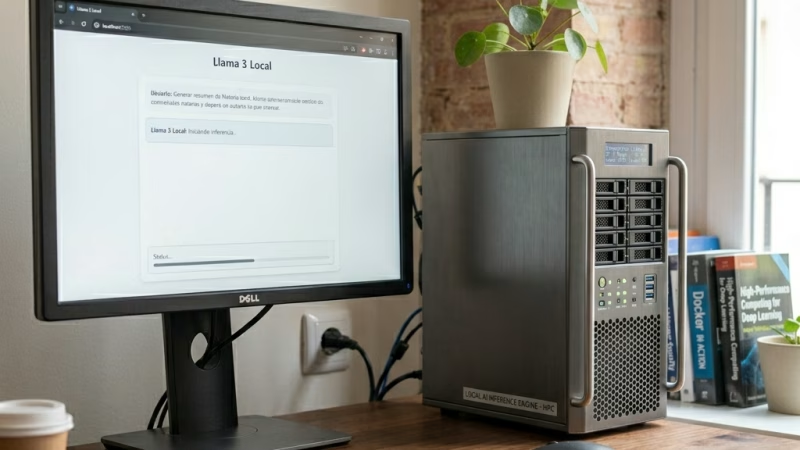
For the general user, platforms exist that package the complexity into simple interfaces. Tools like Ollama allow you to download and run models (like Llama 3 or Gemma) with a single command, acting as a background server. LM Studio offers a graphical interface similar to any conventional desktop application to search, download, and chat with hundreds of open-source models available on repositories like Hugging Face.
Quantization Formats (GGUF and AWQ)
You will encounter models with strange file extensions. Quantization is the technical process of reducing the mathematical precision of the model (from 16-bit to 4-bit, for example) so that it takes up less space in your RAM/VRAM and runs faster, in exchange for a marginal loss of "intelligence". The GGUF format has established itself as the standard for running primarily on CPUs, while AWQ or EXL2 are formats optimized to get the most out of high-performance graphics cards.
Power Consumption: The Hidden Cost in Your Electricity Bill
We must be realistic about the implications of maintaining a server at home. Hardware has an acquisition cost, but it also has a running operational cost.
Efficiency vs. Raw Performance
In countries like Spain, with tiered hourly structures and fluctuating electricity prices, keeping a conventional PC server running 24/7 (waiting for you to speak to your smart assistant) has a real impact. A PC with a powerful graphics card in an idle state can consume between 60W and 100W. When you ask it a query and the GPU revs up to 100%, consumption can spike above 400W.
The reality of the energy market
If the AI is integrated into your home automation and "thinks" several times an hour throughout the day, you must add an extra cost to your monthly electric bill. Calculating based on current 2026 averages, an active server can add between €8 and €15 monthly to your utility bill.
The role of Mini PCs and NPUs
To mitigate this cost, many users who do not require extremely complex reasoning are opting for low-power Mini PCs or laptops that integrate modern Neural Processing Units (NPUs). Although they cannot match a dedicated desktop graphics card, they consume a fraction of the energy (15W - 45W) and are perfectly sufficient for assisting with basic local home automation tasks.
Final Verdict: Is It Time to Buy or Better to Wait?
We arrive at the mandatory conclusion after evaluating the pieces on the 2026 board. If you ask for a firm verdict based on real market conditions:
Do NOT buy a Home AI Server if: Your only goal is to "try out" artificial intelligence, generate a couple of images out of curiosity, or use it as an advanced search engine. The initial cost (easily exceeding €1,200 - €1,500 for a decent base machine, keeping in mind VRAM prices and that even minor components like a basic SSD already cost €50), coupled with maintenance and electricity consumption, simply does not justify the expense. Cloud subscriptions remain infinitely more cost-effective for sporadic or standard professional use.
You SHOULD make the leap if: You are a developer who needs to test code against local models without paying API usage fees, a home automation enthusiast (Home Assistant) who values absolute domestic privacy above cost, or a small business needing to process highly confidential internal documents that, due to data protection regulations, cannot physically leave the premises.
The necessary hardware is expensive, the electrical consumption is not negligible, and the learning curve, although smoothed out, still exists. Local AI in 2026 is perfectly functional and extraordinarily powerful, but from a strictly financial perspective, it remains a luxury for enthusiasts and a niche tool for professionals obsessed with data sovereignty.