Quantum physics slows down AI's energy consumption
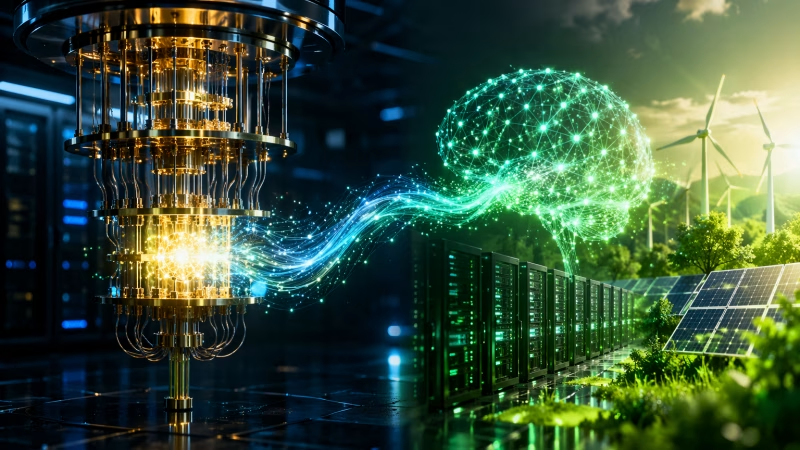
As artificial intelligence integrates into every aspect of our lives and economy in this 2026, an invisible but colossal problem arises: extreme energy consumption. Massive language models and AI infrastructures have pushed data centers to the limit of their capacity, forcing the global tech industry to seek cleaner and more efficient processing alternatives.
The unsustainable challenge of traditional data centers
The adoption of autonomous "AI agents" and multimodal models has skyrocketed the need for continuous computing power. According to the latest digital infrastructure reports, the current transformation demands data volumes that classical technologies process at a very high environmental cost.
Currently, data center operators in Europe and America are facing serious difficulties. Short-term solutions, such as heat recovery for urban networks or advanced geothermal cooling systems, are mitigating the impact, but do not solve the root problem: classical processors have hit their efficiency ceiling when facing algorithms of such magnitude.
The disruption of quantum computing in 2026
Today, April 13, 2026, the industry has received a crucial boost. In the context of global economic and technological debates, industry leaders like D-Wave Quantum have demonstrated that commercial quantum computing has left the experimental phase to become the pillar that will sustain the Artificial Intelligence of the future.
The practical applications of quantum systems in combination with AI promise to revolutionize the digital ecosystem thanks to unparalleled advantages:
- Unprecedented energy efficiency: Quantum processing systems (both annealing and gate-model) can perform complex calculations consuming a minuscule fraction of the energy required by a traditional supercomputer.
- Algorithmic optimization: They solve massive mathematical problems simultaneously, drastically accelerating the training of neural networks without overheating the hardware.
- Sustainable digital sovereignty: They allow countries to host extremely powerful AI infrastructures while meeting strict global emission reduction and ecological transition goals.
The dawn of a new technological era
This synergy marks a turning point in the history of technological development. It is no longer just about creating smarter or faster artificial intelligence, but about making it viable in the long term. The incorporation of hybrid architectures, where AI algorithms offload their heaviest workloads to quantum processors, will cease to be science fiction and become the industry standard in the coming months.
For companies and governments, the message is clear: survival in the artificial intelligence race no longer depends solely on the volume of data, but on the ability to process it using next-generation technologies that respect the resource limits of our planet.