OpenGate-1: Open Source AI Fights Back
OpenGate-1: The Open Source Giant Challenging GPT-5
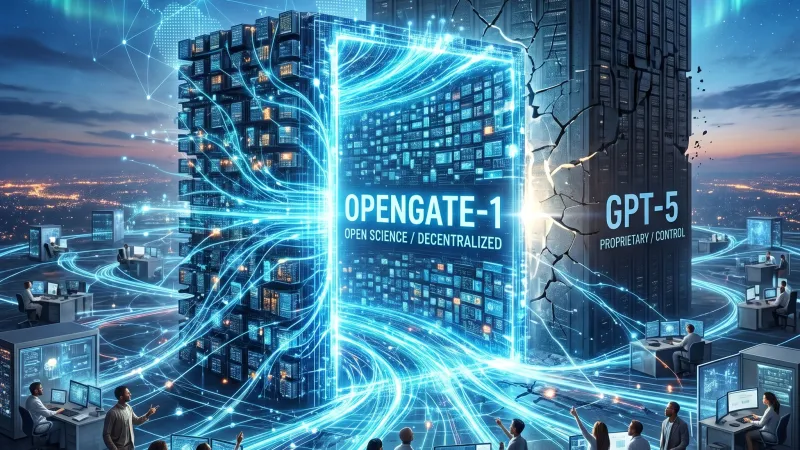
Today, May 3, 2026, just 24 hours after the launch of GPT-5, the global developer community has made a definitive statement. A consortium of independent laboratories has announced the successful deployment of OpenGate-1, the most ambitious open-source model in history, trained outside of massive corporate data centers using a distributed computing network.
The Democratization of Massive Training
OpenGate-1 is the result of a coordinated effort over the last six months, utilizing the Peer-to-Train network protocol. For the first time, a 1.5 trillion parameter model has been processed using the surplus computing power of thousands of nodes worldwide, proving that a private "Stargate" is not strictly necessary to reach the frontiers of artificial intelligence.
The technical milestones of OpenGate-1 presented today include:
- Dynamic Modular Architecture: Unlike monolithic models, OpenGate-1 allows for the loading of specific "experts" depending on the task, optimizing VRAM usage on consumer hardware.
- 100% Transparent Weights and Data: As an open science project, both the model's weights and the training dataset are fully auditable, guaranteeing the absence of commercial biases.
- Inference Efficiency: Thanks to a new quantum distillation technique, the model can run on workstations equipped with next-generation hardware (such as the M5-Ultra chip) with astonishing performance.
Strategic Impact on iaflow.es
At www.iaflow.es, we see this launch as the beginning of the War for Technological Sovereignty. While GPT-5 offers unmatched power under a closed control and subscription model, OpenGate-1 gives companies the ability to own their intelligence without relying on external APIs. This is vital for sectors handling sensitive data that cannot afford the opacity of major AI labs.
The success of OpenGate-1 validates that the open-source community remains the necessary counterweight to prevent an absolute monopoly on AGI.
What Does This Mean for Developers?
As of today, the tools to build high-fidelity autonomous agents are available to everyone. OpenGate-1 is natively compatible with the Agentic-Mesh protocol, meaning these open models can immediately start collaborating with AIs from Google or Meta, leveling the playing field. May 2026 continues to demonstrate that AI does not have a single owner, but multiple fronts of innovation.