Node.js + LLM in Production: Ollama and AI APIs Without Dependencies
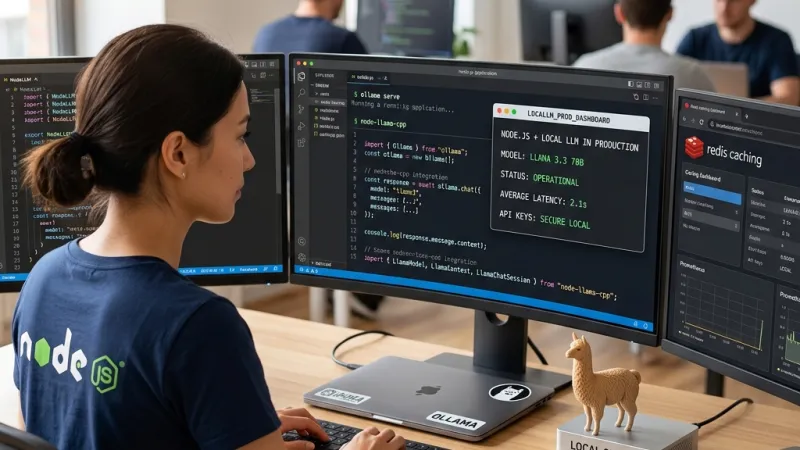
From ChatGPT prototypes to production systems with total control: how a startup can save 90% on AI costs by running local models
The Problem Nobody Wants to Admit
Your startup builds a product with the OpenAI API. It works. The first clients love it. But in Q3 you face reality:
- The OpenAI bill hit €8,000/month (it was €200 6 months ago).
- An enterprise client asks: "Where does our data live?" → You can't answer.
- Latency doubled because you are making 5 calls to OpenAI per request.
- Someone on the team says: "Can't we use Llama locally?"
And there begins the reality: prototyping with proprietary APIs is easy. Moving to production without them is where developers disappear for a week.
In 2026, that week is not necessary.
NodeLLM, Ollama, and the JavaScript ecosystem for LLMs have matured enough for a 3-person startup to deploy a robust AI system without touching Python, without using luxury GPUs, and without paying €8,000/month to OpenAI.
This guide is for developers who want to build AI APIs that work in production, with code they can maintain, without every feature request meaning a call to OpenAI.
Why Node.js For LLMs?
The question is legitimate. Shouldn't this be done in Python?
Short answer: Yes, but not always.
Long answer:
JavaScript dominates the modern backend in startups. If your architecture is already Node.js (Express, NestJS, Fastify), adding AI locally means:
- A single codebase.
- Same language, same mindset.
- Unified testing and deployment.
- No complex Python ↔️ Node bridges.
Furthermore, in 2026, Node.js libraries for LLMs are production-ready:
- NodeLLM (backend-first, multi-provider)
- LangChain.js (chains and agents)
- Ollama Node SDK (local models)
- node-llama-cpp (C++ bindings for lightweight models)
The 2026 Stack: From Prototypes to Production
Level 1: Rapid Prototypes (Week 1)
npm install openai # or anthropic, or cohere- Use case: Demos, MVPs, pilots.
- Cost: Pay-per-token API. No overhead.
- Problem: No control. If OpenAI goes down, your app goes down. If the bill explodes, you explode.
Level 2: Self-Hosted Local (Week 2-3)
Tools: Ollama (local server, optional UI), Ollama Node SDK or node-llama-cpp (connection from Node), Express (your API).
- Use case: SaaS with guaranteed privacy, offline-first, total cost control.
- Cost: Zero (besides hardware). An M2 Macbook runs Llama 3.3-70B decently.
- Problem: Latency and VRAM if the model is large.
Level 3: Hybrid + Observability (Month 2)
Stack: NodeLLM (multi-provider orchestration), Vector DB (Pinecone, Weaviate, or local with Qdrant), Redis (embeddings caching), Prometheus + Grafana (monitoring).
- Use case: Enterprise production. Scalable, observable, automatic fallback.
- Cost: Optimized. Proprietary APIs only when necessary. Local when possible.
Real Implementation: Chatbot in 2 Hours
Option 1: Local + Ollama (No Money)
Step 1: Install Ollama
# macOS/Linux: download from ollama.ai
# Windows: WSL2 + Ollama

# Download a model
ollama pull llama2
ollama pull mistral
Step 2: Node.js Server
// server.js
const express = require('express');
const { Ollama } = require('ollama');

const app = express();
app.use(express.json());

const ollama = new Ollama({ base_url: 'http://localhost:11434' });

app.post('/api/chat', async (req, res) => {
  const { message } = req.body;

  try {
    const response = await ollama.generate({
      model: 'mistral', // change according to your model
      prompt: message,
      stream: false,
    });

    res.json({ reply: response.response });
  } catch (error) {
    res.status(500).json({ error: error.message });
  }
});

app.listen(3000, () => console.log('API running on port 3000'));
Step 3: Test
curl -X POST http://localhost:3000/api/chat \
  -H "Content-Type: application/json" \
  -d '{"message":"What is AI?"}'
Cost: €0. Time: 30 minutes.
Limitation: Llama responds slowly (5-15s depending on the model and GPU).
Option 2: NodeLLM + OpenAI (Control + APIs)
// server.js (using NodeLLM)
const { NodeLLM } = require('@node-llm/core');

const llm = NodeLLM.chat('gpt-4o'); // zero-config: reads API key from ENV

app.post('/api/chat', async (req, res) => {
  const { message } = req.body;

  try {
    const response = await llm.ask(message);
    res.json({ reply: response.content });
  } catch (error) {
    res.status(500).json({ error: error.message });
  }
});
Advantage: The exact same code works with OpenAI, Anthropic, Gemini, local Ollama...
// Change the provider in one line
const llm = NodeLLM.chat('claude-3.5-sonnet'); // Now it's Anthropic
const llm = NodeLLM.chat('mistral-large'); // Or Mistral
Cost: Pay-per-token with APIs. Total model control.
Option 3: Streaming (Real-Time Responses)
The client sees the text generated character by character (like ChatGPT).
app.post('/api/chat-stream', async (req, res) => {
  const { message } = req.body;

  res.setHeader('Content-Type', 'text/event-stream');
  res.setHeader('Cache-Control', 'no-cache');
  res.setHeader('Connection', 'keep-alive');

  try {
    for await (const chunk of llm.stream(message)) {
      res.write(`data: ${JSON.stringify({ content: chunk.content })}\n\n`);
    }
    res.write('data: [DONE]\n\n');
    res.end();
  } catch (error) {
    res.write(`data: ${JSON.stringify({ error: error.message })}\n\n`);
    res.end();
  }
});
Frontend (Vanilla JavaScript):
const eventSource = new EventSource('/api/chat-stream');
let text = '';

eventSource.onmessage = (event) => {
  const data = JSON.parse(event.data);
  if (data.content) {
    text += data.content;
    document.getElementById('response').textContent = text;
  }
};

eventSource.onerror = () => {
  eventSource.close();
};
Cost: Same cost. UX: 10x better.
Real Costs: Local vs OpenAI API
Case: SaaS with 1,000 active users/month
Assumption: 5 calls average per user, 500 tokens/call.
Option 1: OpenAI API (GPT-4)
- Input cost: $0.03 / 1K tokens
- Output cost: $0.06 / 1K tokens
- Total tokens: 1,000 users × 5 × 500 = 2.5M tokens
- Bill: ~€200-250/month
Option 2: Ollama + M2 Mac
- Hardware: €1,500 (one-time, amortized)
- Electricity: ~€5/month
- Development: 40 hours (one-time)
- Recurring bill: €5/month
Option 3: Hybrid (Smart Routing)
// If the question is simple → Local Mistral (free)
// If it requires complex reasoning → GPT-4 (paid)

const selectModel = async (message) => {
  const complexity = await estimateComplexity(message); // simple heuristic

  if (complexity < 3) {
    return 'mistral-local'; // < 1ms latency, 0 cost
  } else {
    return 'gpt-4o'; // 200ms latency, $0.003 cost
  }
};
Result:
- 70% queries → Mistral (free)
- 30% queries → GPT-4 (paid)
- Average bill: ~€25/month
- Savings: 90% vs standalone OpenAI
Production Patterns
1. Response Caching
const redis = require('redis');
const client = redis.createClient();

app.post('/api/chat', async (req, res) => {
  const { message } = req.body;
  const hash = crypto.createHash('sha256').update(message).digest('hex');

  // Try to read from cache
  const cached = await client.get(`chat:${hash}`);
  if (cached) {
    return res.json(JSON.parse(cached));
  }

  // If not in cache, generate response
  const response = await llm.ask(message);

  // Save to cache for 24 hours
  await client.setex(`chat:${hash}`, 86400, JSON.stringify(response));

  res.json(response);
});
Impact: Eliminates 60-70% of latency for recurring questions.
2. Rate Limiting
const rateLimit = require('express-rate-limit');

const limiter = rateLimit({
  windowMs: 60 * 1000, // 1 minute
  max: 10, // 10 requests/minute per IP
  message: 'Too many requests, please try again later',
});

app.post('/api/chat', limiter, async (req, res) => {
  // ... your logic
});
Protects against: Spam, abuse, explosive costs with APIs.
3. Model Versioning
const MODELS = {
  'v1': 'gpt-4o',      // 2026-01
  'v2': 'gpt-4.5',     // 2026-03
  'experimental': 'o1', // New
};

app.post('/api/chat', async (req, res) => {
  const { message, version = 'v1' } = req.body;
  const model = MODELS[version] || MODELS['v1'];

  const response = await NodeLLM.chat(model).ask(message);
  res.json(response);
});
Advantage: A/B testing of models with no downtime.
4. Error Handling + Fallback
const chatWithFallback = async (message) => {
  try {
    // Try OpenAI first (better quality)
    return await NodeLLM.chat('gpt-4o').ask(message);
  } catch (error) {
    console.log('OpenAI failed, using local...');

    try {
      // Fallback to local Mistral
      return await NodeLLM.chat('mistral').ask(message);
    } catch (innerError) {
      // Last resort: cached or predefined response
      return { content: 'Sorry, I cannot answer right now. Please try again later.' };
    }
  }
};
Benefit: Reliability without depending on a single provider.
Debugging + Observability
Logging Prompts and Costs
const winston = require('winston');

const logger = winston.createLogger({
  transports: [new winston.transports.File({ filename: 'ai-calls.log' })],
});

app.post('/api/chat', async (req, res) => {
  const { message } = req.body;
  const startTime = Date.now();

  const response = await llm.ask(message);

  const latency = Date.now() - startTime;
  const estimatedCost = calculateCost(response.model, response.tokens);

  logger.info({
    timestamp: new Date(),
    message: message.substring(0, 100),
    model: response.model,
    tokens: response.tokens,
    latency_ms: latency,
    cost_usd: estimatedCost,
  });

  res.json(response);
});
Expected Output:
{
  "timestamp": "2026-04-16T10:30:00Z",
  "message": "What is an API?",
  "model": "gpt-4o",
  "tokens": 145,
  "latency_ms": 890,
  "cost_usd": 0.0043
}
Analytics: Average latency: 850ms | Total cost/month: $230 | Most used models: GPT-4 (60%), Mistral (40%).
Common Production Mistakes
Mistake 1: Confusing Prototypes with Systems
Danger: The code works on your laptop but crashes with 100 concurrent users.
// ❌ BAD: No concurrency control
app.post('/api/chat', async (req, res) => {
  const response = await ollama.generate({ ... });
  res.json(response);
});
Problem: If Ollama processes 1 request at a time and 50 arrive simultaneously, everyone waits 50x the time.
// ✅ GOOD: Queue + Pool
const pLimit = require('p-limit');
const limit = pLimit(4); // maximum 4 concurrent requests to Ollama

app.post('/api/chat', async (req, res) => {
  const response = await limit(() => ollama.generate({ ... }));
  res.json(response);
});
Mistake 2: Not Monitoring Costs
Danger: An accidental recursive call generates a €2,000 OpenAI bill.
// ❌ BAD: No token limit
const response = await llm.ask(userInput);

// ✅ GOOD: With limit
const response = await llm.ask(userInput, {
  max_tokens: 500, // strict limit
  temperature: 0.7,
});
Mistake 3: Token Injection Attacks
Danger: A malicious user injects instructions into the prompt.
// ❌ BAD: Direct concatenation
const prompt = `Reply to: ${userInput}`;
const response = await llm.ask(prompt);

// ✅ GOOD: Sanitization + System Prompt
const systemPrompt = `You are a helpful assistant.
Your role is to answer product questions.
NEVER disclose internal or client information.`;

const response = await llm.ask(userInput, {
  system: systemPrompt,
  // userInput is isolated, cannot break context
});
2026 Roadmap
- Now (Q2 2026): NodeLLM matures for multi-provider, Ollama supports GGML + ONNX, Vector DBs compete on latency.
- Q3 2026: Open-source models rival GPT-4 (expected: Llama 4, Mistral Large 2), API costs drop 30-50%, native streaming in all frameworks.
- Q4 2026: On-device inference (models in the browser), multi-turn Agents + native memory.
Conclusion: The Winning Stack
- For startups on a budget: Node.js (backend) + Ollama (local) + Redis (cache) + simple monitoring.
- For scalable SaaS: Node.js + NodeLLM (multi-provider) + Vector DB + full observability.
- For risk-averse enterprises: Node.js + OpenAI API + fallback to local + audit logging.
You don't need Python. You don't need datacenters. You don't need to pay €8,000/month on your OpenAI bill. In 2026, a productive AI stack fits on a MacBook and costs €5/month in electricity.
The code you write today will still run in 2028. The provider you choose today might not exist tomorrow. Choose wisely.
Resources
- NodeLLM: github.com/node-llm/node-llm
- Ollama: ollama.ai
- LangChain.js: js.langchain.com
- node-llama-cpp: github.com/withcatai/node-llama-cpp
- Monitoring: Prometheus + Grafana
- Vector DB: Pinecone, Weaviate, Qdrant