Boston Dynamics' Atlas Deployed in Factories
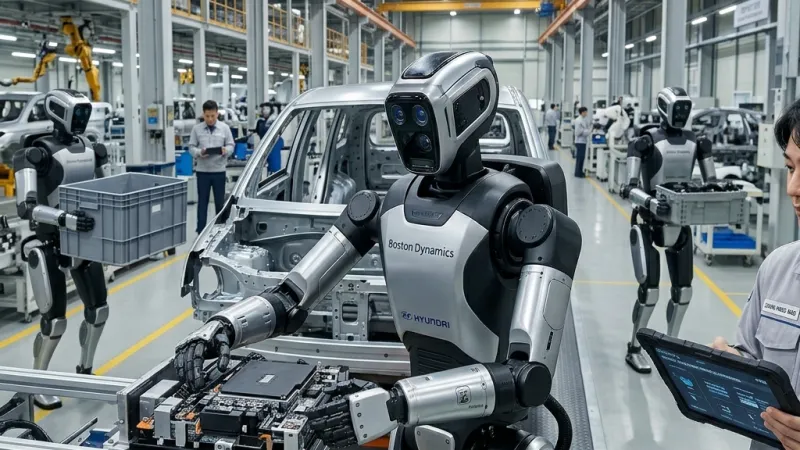
The End of Theory: Boston Dynamics Begins Real Deployment of Atlas in Hyundai Factories
When science fiction becomes the new factory floor.
Introduction: The Silent Revolution Reaches Production Lines
For decades, humanoid robots were synonymous with science fiction. We've seen C-3PO moving boxes in an imaginary warehouse, a T-800 chasing humans on the streets of Los Angeles, and countless bipedal machines dominating movies and video games. But all of that was fiction, entertainment, speculation about a distant future.
Until now.
In this year 2026, Boston Dynamics has crossed a line that very few thought achievable in our time: moving from viral YouTube videos to massive implementation in real industrial environments. Their humanoid robot Atlas is not in a dazzling, clean, and controlled lab. It is in Hyundai's factories, working side-by-side with human engineers, backed by a projected production capacity of 30,000 units annually.
This is not a tech demo. It is an absolute paradigm shift in global manufacturing.
Context: From YouTube to the Production Line
The Boston Dynamics Path
Boston Dynamics has been a fascinating but seemingly "distant" company for years. Their viral videos showed robots doing parkour, dancing in coordination, or navigating complex terrains. They were impressive spectacles that left engineers, investors, and everyday citizens wondering: "When will we see this in real life?"
The answer was closer than we imagined. The company, originally incubated in Google X Labs, was sold to Hyundai Motor Group in 2020. This move was strategic: Hyundai needed world-class robotics; Boston Dynamics needed industrial scale to validate its technology. Four years of joint research have led to this moment: Atlas is no longer a prototype. It is a viable mass-produced product.
Why Now? The Perfect Conditions
Three factors converged in the 2025-2026 period to make the impossible possible:
- Mature Artificial Intelligence: AI-based computer vision and motor control models have reached a level of precision that allows machines to operate in unstructured environments, adjusting trajectories and identifying obstacles in real-time.
- Available Computational Infrastructure: Next-generation AI chips (Nvidia H100, TPU v5) allow Atlas to have its "brain" embedded in its body, without requiring a constant connection to remote data centers.
- Labor and Cost Pressure: The critical shortage of manual labor in repetitive and physically demanding tasks makes a robot that works the equivalent of 2-3 humans without rest economically irresistible.
Atlas Deployment: Specs and Capabilities
| Technical Specifications: Atlas Robot (2026 Generation) | |
|---|---|
| Height / Weight | 1.7 meters (5'7") / 89 kg (196 lbs) |
| Mechanics | 28 actuated joints |
| Payload | 25 kg (55 lbs) per arm |
| Movement Speed | 1.5 m/s (walking), 2.0 m/s (jogging) |
| Battery Autonomy | 8 hours in continuous operation |
| Sensory Hardware | 12 RGB-D cameras + LiDAR |
| Decision Capacity | Based on AI models with 50+ million parameters |
| Operation Interface | AI-assisted teleoperation + supervised autonomy |
Assigned Tasks on the Production Line
- Small Component Assembly: Its anthropomorphic hands allow it to manipulate precision parts and identify micrometric defects thanks to its advanced vision.
- Load Movement: Spends 40% of its time transporting components up to 25 kg per arm between stations, without cumulative fatigue.
- Quality Inspection: Inspects welds and electrical connections at a speed three times faster than a human inspector.
- Predictive Maintenance: Detects thermal or acoustic anomalies in surrounding machinery to prevent costly failures.
- Emergency Response: Intervenes in hazardous zones to isolate machinery or disconnect circuits without putting human lives at risk.
The Immediate Impact: Numbers That Speak
Productivity and Economic Return
Early implementation yields revealing data. Atlas achieves an 18% reduction in production cycle time and a 34% decrease in quality variability. Economically, its operating cost is around $8 USD per hour (including energy, maintenance, and depreciation), offering an estimated ROI (Return on Investment) of 3.2 years.
The Delicate Labor Aspect
Hyundai has avoided mass layoffs through a relocation strategy:
- 2,300 workers were reclassified to supervisory and robotic maintenance roles.
- 1,800 new positions were created in robotics engineering.
- Key Fact: Workplace injuries stemming from repetitive lifting and chemical handling dropped by 89%.
Why Boston Dynamics Won This Race
While competitors like ABB or KUKA dominate with inflexible robotic arms, Boston Dynamics bet on total versatility.
- Humanoid Morphology: Atlas uses the same tools and infrastructure designed for humans. It doesn't require redesigning the factory layout.
- Advanced Dynamic Balance: Its ultra-fast feedback loop allows it to walk over cables, climb stairs, and navigate chaotic environments.
- Multi-modal Perception: It understands its environment in a "sensory" way using 3D depth, infrared, and tactile contact.
- Hybrid Autonomy: It operates 65% autonomously, 25% under minimal supervision, and 10% via assisted teleoperation for critical tasks.
Projections and Challenges (2026-2027)
Currently, in Q2 2026, there are about 50 operational units. Projections aim to surpass 1,000 units in 2027, achieving unit profitability through mass production. However, monumental challenges remain:
- Reliability at Scale: They must guarantee 99.9% uptime to avoid breaking supply chains.
- Initial Cost: Estimated between $150,000 and $200,000 USD per unit, a massive barrier for SMEs.
- Sustainability: Each Atlas consumes between 5 and 7 kWh daily, demanding a restructuring of the industrial power grid.
- Regulation and Unions: IG Metall and other labor unions demand employment guarantees against displacement, and "robot-human" safety regulations are still in their infancy.
Conclusion: The Rubicon Has Been Crossed
Boston Dynamics hasn't invented the future; it has accelerated its arrival. The deployment of Atlas marks the end of the experimental phase and the beginning of the era of massive corporate humanoid management.
The most important question in 2026 is no longer technical, but ethical: How do we ensure that this unprecedented wave of automation benefits society as a whole and not just shareholders? Atlas is working today at Hyundai. Tomorrow, it will be in your city.
To Dig Deeper:
- Track use cases at Boston Dynamics.
- Labor impact analysis: World Economic Forum Future of Jobs Report 2026.
- Competitor developments: Tesla Optimus and Figure AI.